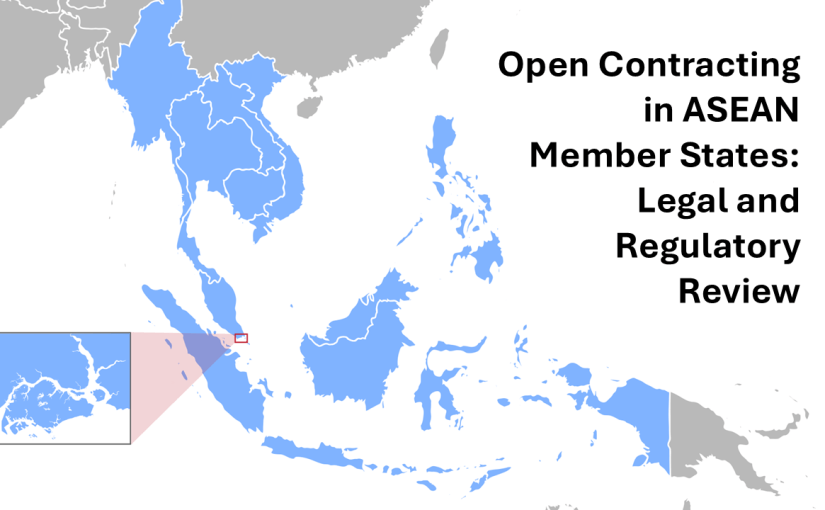

In July 2026 the United Nations Office on Drugs and Crime (UNODC) published a study on how the Association of Southeast Asian Nations (ASEAN) member states have adopted open contracting principles, from a legal and regulatory perspective.
The study drew on benchmarks set forth in the Open Contracting Partnership’s Legislative Guide; that guide identifies ten key legislative and institutional factors (many of which correspond to key requirements from article 9(1) of the United Nations Convention against Corruption (UNCAC)) on transparent and competitive procurement systems. All ASEAN Member States are parties to UNCAC.
Open contracting refers to the proactive disclosure and use of public procurement data across the entire procurement cycle, in open and machine‑readable formats, coupled with opportunities for public participation and oversight.
– UNODC study, at 4
Evidence from multiple regions shows that open contracting can improve value for money, increase competition, enhance procurement efficiency and uncover corruption risks, particularly when implemented through robust e‑procurement platforms and open data standards, such as the Open Contracting Data Standard (OCDS).
Overall, the report found that ASEAN Member States have “laid many of the legal and institutional foundations required for open contracting–particularly in terms of overarching procurement laws, e‑procurement platforms and anti‑corruption frameworks.” At the same time, however, the report concluded that “further measures would support more robust open contracting systems,” through “consolidation of procurement legislation, expansion of e‑procurement, strengthening of integrity rules and consideration of the gradual opening of procurement data to wider scrutiny.”
The study was commissioned by the UNODC Regional Office for Southeast Asia and the Pacific (ROSEAP), with the support of the Ministry of Justice of the Republic of Korea and the U.S. Bureau of International Narcotics and Law Enforcement Affairs.
This study was primarily researched and authored by GW Law’s Professor Christopher Yukins, with substantial contributions by GW Law alumnae Ellen Rolda Simic and Anisley Sanchez, Graeme Gunn and Li Anne Lim of UNODC, and Nishant Bhatnagar and Bernadine Fernz of the Open Contracting Partnership. It was peer-reviewed by UNODC’s Constantine Palicarsky, Minh Nguyen, Vickram Ragunath, Kirbee Tibayan, Putri Wijayanti, Nichanee Wongba and Annika Wythes.
