Category: Uncategorized


Model Procurement Code Reform: Impact of Trump Administration Changes to Grants Requirements
By changing standards for procurement under federal grants, the Trump administration’s proposed changes to the rules guiding federal grantees could impact ongoing reforms of the ABA Model Procurement Code (MPC).
Since it was launched in the late 1970s, the MPC has served as a safe procurement “rulebook” for federal grantees. The MPC was drafted with federal grants standards in mind, so that federal grantees (such as cities and states) can adopt the MPC and be confident that their procurement processes will meet federal requirements.
Those federal standards for grants were revised in 2014 by the U.S. Office of Management and Budget (OMB) (part of the White House) to create “Uniform Guidance,” which is implemented by grants-making federal agencies. In Subpart D, the Uniform Guidance includes procurement standards on issues such as competition, conflicts of interest and contract types.
On May 29, 2026, the Trump administration proposed major changes to the Uniform Guidance (which would be renamed the “Uniform Grants Regulation,” and made a uniform governmentwide rule). Those proposed changes have been controversial in part because they would give political appointees authority to review and approve (or deny) grants based on the incumbent administration’s priorities. Over 160,000 comments on the proposed rule were received in the regulatory docket by the closing date of July 13, 2026, and the new rule is scheduled to be implemented on October 1, 2026 (the start of the federal fiscal year).
As the linked comparison shows, the proposed rule would make significant changes to the existing procurement standards, such as:
- Cost-reimbursement contracts discouraged: The proposed rule would more aggressively discourage the use of cost-reimbursement contracts.
- Small business use encouraged: The proposed rule would amplify the encouragement for grantees to “ensure that small businesses, including subcategories of small businesses enumerated in Federal statute, are considered when issuing contracts.”
- Buy U.S. preference: The proposed rule would strengthen domestic preferences for procurement under federal grants. To the “greatest extent practicable and consistent with law,” agencies are to “include terms and conditions in Federal awards to maximize the use of goods, products, and materials produced in the United States.” These requirements would need to be flowed down to “all subawards, contracts, and purchase orders under Federal awards.”
The proposed rule includes other relevant changes, such as a loosening of the internal controls requirements for grantees. Some of OMB’s proposed changes (for example, an exclusion of Chinese drones) are unlikely to be adopted directly into the MPC, which is a more general set of guiding rules. Other changes to the grants requirements, however, are likely to be included in the MPC.
Those working on proposed updates to the Model Procurement Code may want to track the regulatory docket to stay apprised of these ongoing changes (including the forthcoming final rule from OMB). The hope is that, by incorporating the revised grants requirements, the Code will continue to serve as a reliable rules standard for federal grantees.
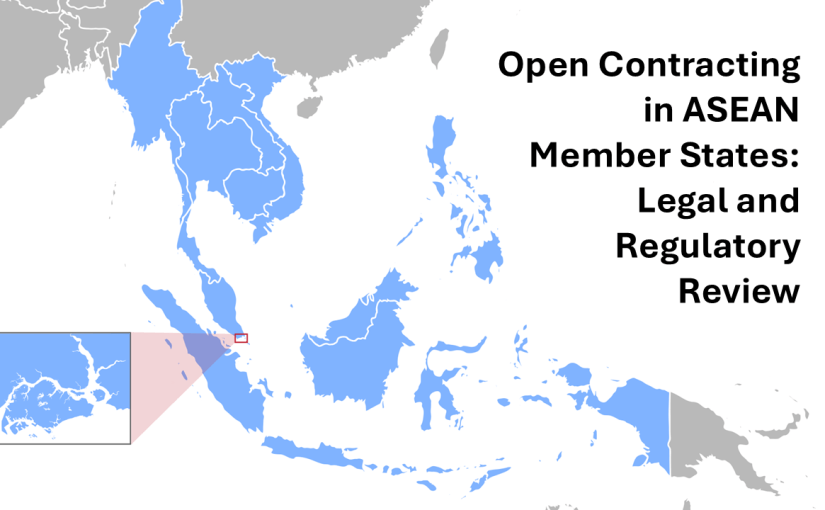
UNODC Study on Open Contracting in the ASEAN Member States

In July 2026 the United Nations Office on Drugs and Crime (UNODC) published a study on how the Association of Southeast Asian Nations (ASEAN) member states have adopted open contracting principles, from a legal and regulatory perspective.
The study drew on benchmarks set forth in the Open Contracting Partnership’s Legislative Guide; that guide identifies ten key legislative and institutional factors (many of which correspond to key requirements from article 9(1) of the United Nations Convention against Corruption (UNCAC)) on transparent and competitive procurement systems. All ASEAN Member States are parties to UNCAC.
Open contracting refers to the proactive disclosure and use of public procurement data across the entire procurement cycle, in open and machine‑readable formats, coupled with opportunities for public participation and oversight.
– UNODC study, at 4
Evidence from multiple regions shows that open contracting can improve value for money, increase competition, enhance procurement efficiency and uncover corruption risks, particularly when implemented through robust e‑procurement platforms and open data standards, such as the Open Contracting Data Standard (OCDS).
Overall, the report found that ASEAN Member States have “laid many of the legal and institutional foundations required for open contracting–particularly in terms of overarching procurement laws, e‑procurement platforms and anti‑corruption frameworks.” At the same time, however, the report concluded that “further measures would support more robust open contracting systems,” through “consolidation of procurement legislation, expansion of e‑procurement, strengthening of integrity rules and consideration of the gradual opening of procurement data to wider scrutiny.”
The study was commissioned by the UNODC Regional Office for Southeast Asia and the Pacific (ROSEAP), with the support of the Ministry of Justice of the Republic of Korea and the U.S. Bureau of International Narcotics and Law Enforcement Affairs.
This study was primarily researched and authored by GW Law’s Professor Christopher Yukins, with substantial contributions by GW Law alumnae Ellen Rolda Simic and Anisley Sanchez, Graeme Gunn and Li Anne Lim of UNODC, and Nishant Bhatnagar and Bernadine Fernz of the Open Contracting Partnership. It was peer-reviewed by UNODC’s Constantine Palicarsky, Minh Nguyen, Vickram Ragunath, Kirbee Tibayan, Putri Wijayanti, Nichanee Wongba and Annika Wythes.

Mediation in Public Procurement Disputes – Address on UNCITRAL’s 60th Anniversary
Professor Christopher Yukins (George Washington University Law School) speaks on the potential use of mediation in public procurement disputes, including under the UNCITRAL Model Law on Public Procurement (2011) (which may be opened for targeted reforms) and the UNCITRAL Mediation Rules (2021). The recording (YouTube & archive) was to be delivered as part of the International Conference Commemorating UNCITRAL’s 60th Anniversary, New Delhi, India, 26 July 2026.
For more information on GW Law’s webinar series on UNCITRAL and other issues in international development, click below:

Comments to NYC Commission on Government Efficiency: Speeding Up Public Procurement
Author’s note: In May 2026, New York City Mayor Zohran Mamdani announced the appointment of the Commission on Government Efficiency, or COGE, a Charter Revision Commission tasked with making City government work better. Led by Chair Patrick Gaspard (see video below), COGE will examine how the New York City Charter can be amended to improve the City’s government. These comments were submitted to the July 6, 2026 hearing dedicated to procurement issues, held on Staten Island.
To the Members of the Commission on Government Efficiency:
Thank you for this opportunity to submit comments on the reforms to the New York City Charter being considered by the Mayor’s Commission on Government Efficiency. I write regarding the topic of today’s hearing, speeding up New York City’s public procurement.

My Background: I serve as the Lynn David Research Professor in Government Procurement Law at George Washington University Law School in Washington, D.C., one of the leading public procurement law programs in the world. I have taught at GW Law since 2002, including on state and municipal procurement law. My comments here reflect my own views and do not represent those of GW Law or any other institution.
I have extensive ties to New York City. I am a member of the New York State bar, and I served as a judicial clerk to Judge Lawrence W. Pierce of the U.S. Court of Appeals for the Second Circuit in Manhattan. My wife and I lived in New York for many years, as I practiced law there and she served as a dean of graduate schools of education in New York City.
Model Procurement Code (MPC): I work on a number of procurement law initiatives, both nationally and internationally. I previously served as an advisor to the U.S. delegation in a sweeping reform of the United Nations Commission on International Trade Law (UNCITRAL) Model Law on Public Procurement. I also serve as the Academic Advisor to an ongoing reform of the 2000 American Bar Association (ABA) Model Procurement Code(MPC), which is coordinated by the ABA Public Contract Law Section, the National Association of State Procurement Officials (NASPO) and Partners for Public Good.

Since it was first adopted in 1979, the ABA Model Procurement Code has guided public procurement laws across the United States. According to the Model Procurement Code Revision Project more than 20 states, from New Mexico to South Carolina, have enacted legislation based on the MPC. Many other major governments – including New York City – have relied on the Model Procurement Code as a guiding standard to promote best‑value procurement and the ethical stewardship of taxpayer dollars.
Commission’s Potential Procurement Reforms: As the Commission’s preliminary report pointed out, the last major reform of the City’s charter in 1989 drew directly on the ABA Model Procurement Code. The Model Procurement Code was subsequently overhauled in 2000, and as noted is now being reformed again. Those changes to the Model Procurement Code may help inform the Commission’s proposed amendments to the chapter in the City’s Charter which addresses procurement.
The Commission’s preliminary report suggested a number of potential reforms to the City’s $50 billion contracting system in response to public concerns. Those reforms often intersect with changes considered under the Model Procurement Code and around the world.
Reducing Paperwork: The Commission’s preliminary report suggested that, to reduce burdens on small businesses and other vendors, the Commission may consider streamlining vendors’ qualification questionnaires. Because vendors typically work in broader markets, the City could draw on other governments’ initiatives to share contractor qualification information (including anti-corruption information and past performance data). The City, following a model being developed in the European Union, could use other governments’ qualification information to reduce vendors’ burdens while at the same time reducing the City’s own performance and corruption risks. The Open Contracting Partnership, among others, is working closely with governments across the world (and the United States, including Portland and Boston) to make procurement data publicly available and machine-readable – cornerstones to efficiency, accountability and a healthy public procurement system.

Eliminating a requirement for public hearings: The Commission suggested eliminating required public hearings before certain contract awards (see Section 326 of the Charter). If, as discussed above, the City follows the global trend towards open contracting – making critical procurement information publicly available – the current comment period will be far more efficient than public hearings.
Delegating authority to contracting officials: The Commission’s preliminary report recommended that the Mayor be permitted to delegate procurement approvals to agency chief contracting officers. This would echo a nationwide trend to giving contracting officials more authority, to allow them to innovate and to be more responsive to the needs of government users and the public. The Model Procurement Code’s current reforms are, at their core, driven by the advancing professionalization of procurement officials, and New York City could improve procurement outcomes by embracing that trend. In practical terms that means (among other things) investing in the professional advancement of procurement officials, through training offered by NASPO, NIGP, the National Contract Management Association (NCMA) and other professional training providers.

Innovation and Procurement: The Commission’s preliminary report noted the need to reform procurement “to better match the challenge of acquiring effective technology, strengthening the City’s in-house roster of technologists, and breaking down IT barriers across City agencies and functions.” In the procurement community, this policy question breaks down into three inter-related components: (i) innovation in procurement (improved procurement processes to buy better technology); (ii) procurement of innovation (buying the best technology); and (iii) procurement for innovation (using public procurement to spur cutting-edge technologies in the broader economy). The Commission may want to consider reforms from each of these perspectives. Improving procurement processes to welcome new market entrants, for example, may make it easier for New York City to access new technologies and could boost high technology start-up firms in the City.
Streamlining Reports: The Commission’s preliminary report suggests that the Charter might be amended to reduce unnecessary reports by City procurement officials. First, the Commission suggests that the Charter’s requirement that the Procurement Policy Board “submit an annual report . . . setting forth the professional standards for agency contracting officers . . . including any applicable certification process” is outdated and could be replaced by more modern methods of training and certification. The Trump administration’s “Revolutionary FAR Overhaul” has done extensive work in this area. Federal reformers have developed “practitioner albums” that can be readily updated to meet procurement officials’ evolving needs for training and guidance; New York City may want to follow a similar approach.

Second, the Commission suggested that the forward-looking plans and hearings required by the Charter for client services contracting could be streamlined. (This streamlining may be especially appropriate because the City’s procurement regulations separately require that, before a client services solicitation is issued, a “concept plan” be published.) Publishing plans for future procurement is a sound practice, but as the Guide to Enactment which accompanies Article 6 of the United Nations Commission on International Trade Law’s model law explains:
The purpose of [non-mandatory publication] is to highlight the importance of proper procurement planning for procuring entities and suppliers and contractors alike. The article recommends the publication of information on future procurement, which may contribute to transparency throughout the procurement process and eliminate any advantageous position of suppliers or contractors that might otherwise gain access to procurement planning phases in a non-transparent way.
Thus it makes sense to call for advance notice of distant procurements only when doing so would enhance the integrity of the competitive process or would provide essential transparency to vendors, client communities and the broader public.
Conclusion: Thank you again for this opportunity to submit comments on these important reforms. Should you or your staff have any questions, please feel free to reach out to me through the background link noted above.
Author’s Note: The July 7, 2026 supplemental comments below followed up on the Commission hearing, and focused on strategies for reducing delays in procurement.
Thank you for the opportunity to speak with the Commission at yesterday’s Staten Island hearing on the reforms to the New York City Charter being considered by the Mayor’s Commission on Government Efficiency, regarding speeding up New York City’s roughly $50 billion public procurement system. These supplemental comments respond to a question raised at yesterday’s hearing by Commission Chairman Patrick Gaspard.
The majority of the testimony at yesterday’s hearing came from non-profit contractors that provide social services – such as housing for persons without homes – to the City of New York. Those contractors voiced one recurring complaint with the City’s procurement system: delays in contract awards and payments. When they presented, the City’s contracting officials also discussed extensive efforts that the City has made to shorten procurement time cycles. When my turn came to address the Commission, the Chairman put that same issue to me: what can New York City learn from other systems so as to reduce these procurement delays?
One very thorough study of procurement delays was done in 2024 by the U.S. Government Accountability Office (GAO) (GAO Report No. 24-106528) regarding delays in federal procurement. GAO focused on strategies used to reduce the time from solicitation to contract award, which is referred to as “procurement administrative lead time” (PALT).

In that study, GAO noted that the U.S. Office of Management and Budget had issued a policy memorandum in 2021 outlining a series of measures agencies can use to reduce PALT. While New York City has adopted many of those strategies (such as monitoring contracting delays across the enterprise), the Commission may wish to consider other innovative approaches, such as using vendor video presentations to streamline competitions. In a subsequent presentation on its report, GAO emphasized that these innovative strategies must be combined with agency-wide monitoring and accountability in order to reduce delays in the procurement process.
Thank you again for allowing me to submit supplemental comments on the Commission’s important work.

Webinar Series – International Development: New Directions in Procurement

Zagreb Conference: Public Procurement – A New Way Forward

Professor Marko Turudić of the University of Zagreb, in conjunction with Maja Kuhar, president of DKOM (the Croatian remedies/bid protest agency), launched an enormously successful public procurement conference in Zagreb on November 10-11, 2025 (LinkedIn post) — a conference they hope to repeat in future years. GW Law’s Professor Christopher Yukins addressed the Trump administration tariffs in public procurement. Distinguished speakers discussed emerging issues in bid remedies, artificial intelligence, international trade and environmental sustainability.

Procurement-for-Innovation Across Europe — Symposium Series

Procurement, Anti-Corruption and Professionalism Training in Argentina
On October 16, 2025, GW Law’s Professor Christopher Yukins took part online in a program for Argentine judges coordinated by distinguished GW alumna Genoveva Ferrero of the General Secretariat of Administration and Budget of the Judiciary of the City of Buenos Aires, “Programa Intensivo de Perspectivas Comparadas en Derechos Humanos, Justicia Penal y Contratación Pública,” an intensive program on comparative approaches to human rights, criminal law and public procurement. Professor Yukins spoke on “Lucha contra la corrupción y transparencia en la contratación pública” — the fight against corruption in public procurement. Slides

Genoveva Ferrero also helped lead the 3-4 November 2025 Public Procurement Congress held at the Faculty of Law, University of Buenos Aires.
Victoria Christoff, professorial lecturer in law at GW, participated in the Congress, presenting on the current reforms of the U.S. federal procurement system. The panel, moderated by Barbara Fernandez Villa, the sub-secretary of the Cabinet of Ministers for the Republic of Argentina, also included Professor Andrea Sundstrand, professor of public procurement at the University of Stockholm, and a representative from the Office of Economics and Commerce from the European Union delegation in Buenos Aires. Ms. Christoff’s slides (in Spanish) are here.

The Buenos Aires Congress was very much a meeting of procurement professors from around the world. In the photo at left: Andrea Sundstrand (Stockholm University), Sope Williams (Stellenbosch University), Annamaria La Chimia (U. Nottingham), Gabriella Racca (U. Turin), Genoveva Ferrero (organizer), Patricia Valcárcel (U. Vigo), Tünde Tátrai (Corvinus U.) and Victoria Christoff (GW Law).

Appearing by video recording (to facilitate translation), Professor Yukins contributed an online lecture at the Congress in which he assessed the United Kingdom’s Public Sector Fraud Authority — a unique initiative internationally to use classic compliance measures to reduce the risks of fraud and corruption in the public sector.
The panel, moderated by Paola Laurenzano, Procurement Coordinator, United Nations Development Programme (UNDP) Argentina, also included Viviana Mora, Head of the User Management Division of the Public Procurement and Contracting Directorate, ChileCompra, GW Law alumnus Jean-Jacques Verdeaux, Procurement Manager, Latin America and Caribbean Region, The World Bank, and Javier Dávila Pérez, Chief of the Financial Management and Procurement Division, Inter-American Development Bank (IDB). Professor Yukins’ recorded presentation appears below.

Revolutionary FAR Overhaul: Second Round (FAR Part 10 – Market Research)
The Trump administration’s “Revolutionary FAR Overhaul” (RFO) initiative has released its second tranche of proposed changes to the Federal Acquisition Regulation (FAR), this time to FAR Part 10, Market Research. The proposed changes are again generally relatively modest, perhaps because the existing FAR Part 10 was already very short.
What the latest changes do help clarify is how the FAR overhaul will proceed from here. The latest round of changes emphasizes training for the acquisition workforce on the overhauled parts of the FAR, and makes that training interesting and accessible.
But the latest round (and the implementing agencies’ follow-up to the prior round) also confirm how these sudden changes to the FAR will be implemented until formal rulemaking can begin, likely in October 2025: the participating agencies probably will issue class deviations adopting the “model” deviations — the stopgap changes — which have been approved by the FAR Council. As the discussion below explains, this leaves open questions over whether the “revolutionary” overhaul is bypassing the normal publication and comment required by law for changes to the FAR.
Editor’s note: For background on the “Revolutionary FAR overhaul” published in conjunction with the first tranche of changes (to FAR Parts 1 and 34), please click the image below.
FAR Part 10: Market Research – Proposed Changes

Current FAR Part 10 explains how market research should be performed. The current FAR language largely follow mandates from other statutes and regulations: per statutory requirements, for example, FAR Part 10 encourages agencies to do research to enable the use of commercial products, and per title 15, U.S. Code, FAR Part 10 directs agencies to do research so that they can purchase from small businesses where possible. These provisions largely replicate parallel requirements in FAR Parts 7 and 19, and so were deleted in the proposed overhaul.
The proposed new streamlined version of FAR Part 10 shifts much of the direction and encouragement to an informal “Practitioner Album” — a slick, well-designed series of lessons on new approaches to market research, including links to automated tools and resources. The overhaul also promises a future “FAR Companion Guide” which is to include guidance removed from the FAR itself, and which is to afford “acquisition teams greater flexibility and discretion to consider techniques which are most appropriate to their acquisition.”

Emerging Issues with Class Deviations
Potentially more controversial are the class deviations that are being used to implement the FAR overhaul, pending a formal rulemaking process. Without publication or allowing for public comment, the FAR Council has approved class deviations to implement the FAR “overhaul,” class deviations which have simply been adopted by individual agencies (listed in the table below). Direction issued on May 2, 2025 by the FAR Council strongly encouraged the agencies to simply adopt the “model” class deviations prepared by the FAR Council.

Kara Sacilotto, a partner at the Wiley law firm, has published an outstanding overview of the FAR overhaul initiative through Thomson Reuters’ Briefing Papers. Her firm is tracking the FAR overhaul at their “Decoding the FAR Rewrite” page
These class deviations implement the “overhaul” pending a more formal rulemaking process that is to begin once the initial phase of the “overhaul” is complete, probably in October 2025.
Both the first tranche (to FAR Parts 1 and 34) and the second tranche (FAR Part 10) of “revolutionary overhaul” changes have been adopted through class deviations by the same group of civilian agencies (see table below) – as of June 3, 2025, no unit of the Defense Department has put a class deviation in place to implement the overhaul.
| FAR Parts Proposed for “Overhaul”: Agencies Which Have Issued Class Deviations (as of 27 May 2025) | ||
| FAR Part 1 | FAR Part 10 | FAR Part 34 |
| Securities & Exchange Commission (SEC) (May 27, 2025) | SEC (May 27, 2025) | |
| Department of Commerce (DOC) (May 22, 2025) | DOC (May 22, 2025) | |
| Department of Labor (DOL) (May 21, 2025) | DOL (May 21, 2025) | |
| Millennium Challenge Corporation (MCC) (May 8, 2025) | MCC (May 23, 2025) | MCC (May 8, 2025) |
| Consumer Product Safety Commission (CPSC) (May 16, 2025) | CPSC (May 27, 2025) | CPSC (May 16, 2025) |
| General Services Administration (GSA) (April 21, 2025) | GSA (May 22, 2025) | GSA (April 21, 2025) |
The State Department has also adopted the FAR Council’s model class deviations to FAR Parts 1 and 34 — but not to Part 10.
None of these class deviations has included an explanation for why the class deviation at issue was being adopted, other than to note that the FAR Council had approved the model deviation. None of the deviations has explained why they were “necessary to meet [the issuing] agency’s specific needs.” FAR 1.302(a). Nor were any of these class deviations published in the Federal Register.
The class deviations may draw a challenge in court, for example for the agencies’ failure to publish the class deviations in the Federal Register for public comment. In La Gloria Oil & Gas Co. v. United States, 56 Fed. Cl. 211, 220 (2003), abrogated on other grounds by Tesoro Hawaii Corp. v. United States, 405 F.3d 1339, 1349 (Fed. Cir. 2005), Judge Hewitt of the Court of Federal Claims explained that Section 22 of the Office of Federal Procurement Policy Act (now codified at 41 U.S.C. § 1707) requires that an agency publish in the Federal Register proposed changes in “procurement policy, regulation, procedure or form” – including, the court said, the class deviations at issue in that case. See 41 U.S.C. § 1707(a) (“a procurement policy, regulation, procedure, or form (including an amendment or modification thereto) may not take effect until 60 days after it is published for public comment in the Federal Register pursuant to subsection (b) if it— (A) relates to the expenditure of appropriated funds; and (B) (i) has a significant effect beyond the internal operating procedures of the agency issuing the policy, regulation, procedure, or form; or (ii) has a significant cost or administrative impact on contractors or offerors.”); FAR 1.301(b) (“Agency heads shall establish procedures to ensure that agency acquisition regulations are published for comment in the Federal Register . . . as required by 41 U.S.C. 1707, and other applicable statutes, when they have a significant effect beyond the internal operating procedures of the agency or have a significant cost or administrative impact on contractors or offerors.”); see also Sunoco, Inc. v. United States, 59 Fed. Cl. 390, 396 (2004) (class deviation must be published to notify “the public of an immediate and nonpermanent change to the particular regulation”), abrogated on other grounds by Tesoro Hawaii Corp., 405 F.3d at 1349 (Fed. Cir. 2005); Navajo Ref. Co., L.P. v. United States, 58 Fed. Cl. 200, 209 (2003) (although “section 22 of the OFFP Act does not specifically address class deviations, the court finds that a class deviation may fall within any of the various categories of procurement changes identified in the OFFP Act — in particular, changes in procurement policy, regulation, procedure or form — that require publication in the Federal Register under the OFFP Act”); Mr. John Mcnerney Assoc. Dir. Bldg. Div. the Associated Gen. Contractors of Am., Comp. Gen. B-224357.2 (Aug. 31, 1987) (GAO issued finding regarding validity of class deviation under the FAR).
A challenging party may argue that, without publication and an opportunity to comment, affected parties may not have a meaningful opportunity to challenge the class deviations as “precluded by law.” See, e.g., Serv. Emps. Int’l Union, AFL-CIO v. Gen. Servs. Admin., 830 F. Supp. 5, 10 & n.4 (D.D.C. 1993). A challenging party may argue that the class deviations, because issued in violation of publication and other requirements, are therefore invalid and without force. See Aerolease Long Beach v. United States, 31 Fed. Cl. 342, 367, aff’d, 39 F.3d 1198 (Fed. Cir. 1994).
Under FAR 1.301, no publication in the Federal Register would be “required for issuances that merely implement or supplement higher level issuances that have previously undergone the public comment process” – but no public comment process has occurred here, and so that exception from publication would not apply.

Defense Department units that adopt class deviations may face a greater risk of legal challenge because of more stringent requirements under the DoD rules. Defense Federal Acquisition Regulation Supplement (DFARS) 201.402 says that a request for a deviation must include a “detailed rationale for the request,” including a statement of “what problem or situation will be avoided, corrected, or improved if request is approved.” That rationale under the DoD rules would have to explain, as noted, why the DoD class deviation was “necessary to meet [the issuing] agency’s specific needs,” FAR 1.302(a) (emphasis added) – which could be difficult, because the class deviations are clearly being issued to meet a governmentwide goal of streamlining the FAR. Cf. Serv. Emps. Int’l Union, AFL-CIO v. Gen. Servs. Admin., 830 F. Supp. 5, 10 (D.D.C. 1993) (finding agency-specific deviating regulation unlawful under the Administrative Procedure Act (APA) because it was a general cost-cutting measure, and was “not designed to ‘satisfy the specific need of the agency,’” and nothing in the administrative record showed “how this need for cost savings [was] specific or unique to” the issuing agency).
Conclusion
The second round of changes under the “Revolutionary FAR Overhaul,” to FAR Part 10 (Market Research), was not in fact enormously revolutionary. These latest changes do, though, deepen possible concerns about how the overhaul initiative is being undertaken: the FAR Council is simply approving model class deviations, which are in turn being adopted by agencies without the publication and public comment normally required by law for class deviations. This approach has not been terribly controversial so far because the regulations that have been “overhauled” — FAR Parts 1, 10 and 34 — are relatively obscure. The means being used to undertake this “revolutionary FAR overhaul” may, however, prove more controversial as the initiative moves on to more critical parts of the Federal Acquisition Regulation.