Request Denied by GAO for Documents in Pending Protest Regarding GSA “Electronic Marketplaces” Procurement

On January 15, 2020, Overstock.com, Inc., a competitor in the pending U.S. General Services Administration (GSA) procurement for “electronic marketplaces” reportedly protested the reissued (and revised) solicitation at the U.S. Government Accountability Office. Per GAO’s rules on the public availability of records, 4 Code of Federal Regulations (CFR) Part 81, Professor Yukins submitted a formal request to GAO for electronic versions of the redacted materials filed in the referenced pending bid protest (attached).  These records were requested so that information and analysis regarding the subject procurement – a multi-billion dollar procurement to open commercial electronic marketplaces to federal users – can be made available to the public.  If these records are not released, key information on this major procurement may be blocked from the public for roughly three months – the 100-day period for a GAO bid protest to be decided.

On January 22, 2020, GAO denied the request, saying that it is estimated that the documents will not be available until the proceedings are concluded, projected to be on or about April 24, 2020, over three months later. In practical terms, this means that the thousands of vendors and customers which need to prepare for the new electronic markets to be opened by GSA’s procurement may need to wait months for information on the ongoing procurement and protest — even though that information (because redacted) is otherwise publicly releasable.

Roger Waldron, Coalition for Government Procurement

Editor’s Note: On January 24, 2020, the Federal News Network published an op-ed by Roger Waldron of the Coalition for Government Procurement which concluded: “. . . there are broad implications for the procurement system associated with the e-Marketplace acquisition, and those implications extend into other areas of importance, like supply chain security, socioeconomic programs, and the protection of proprietary data. Yukins is right. Absent the release of these [GAO protest] records, ‘key information on this major procurement may be blocked from the public for roughly three months – the 100-day period for a GAO bid protest to be decided.’ So too, from the perspective of Coalition members, it highlights that more review and reflection on the acquisition is needed. “

ABA Committees To Hold Joint Meeting on Developments in International Debarment – February 13, 2020 – Call in

Jessica Tillipman, GWU Law School – Co-chair, ABA SIL Anti-Corruption Committee

On February 13, 2020, at 12:00 noon ET, the American Bar Association (ABA) Section of International Law (SIL) Anti-Corruption Committee will join with the ABA Public Contract Law Section (PCLS) Suspension and Debarment Committee, for an informal lunchtime session on developments in international debarment. The session will be moderated by Assistant Dean Jessica Tillipman, George Washington University Law School, Washington DC.

Christopher Yukins, George Washington University Law School (who co-teaches courses on anti-corruption with Dean Tillipman), will discuss emerging international models for debarment, and the impact that new electronic marketplaces may have on debarment globally.  With regard to the U.S. experience, he has drafted a book chapter with John Pachter and Jessica Tillipman, for a forthcoming book on compliance by Cambridge University Press.  Professor Yukins has also co-written a piece with Professor Michal Kania (U. Silesia – Katowice), comparing debarment in the United States and the European Union.

Pascal Friton, BLOMSTEIN, Berlin

Pascal Friton, a partner in the BLOMSTEIN firm, Berlin, will discuss how the European Union’s member states are addressing exclusion and debarment, drawing on a piece he presented at the Thomson Reuters Government Contracts Year in Review in February 2019.  He also will be speaking on the afternoon of Tuesday, February 18, 2020 at this year’s Year in Review conference.

Collin Swan, World Bank

Collin Swan, of the World Bank’s Office of Suspension & Debarment, will discuss his office’s debarment survey and the office’s ongoing research into other debarment systems (beyond the United States and the World Bank).  See his FCPA Blog post on the survey.

Additional resources

Grace Sullivan, GWU Law

Grace Sullivan, a third-year student at the George Washington University Law School, recently won first prize in the Public Contract Law Journal annual writing contest for her note (which was also accepted for publication in the Journal). Her note analyzes three case studies of foreign contractors debarred by the U.S. government: Chinese telecommunications giants ZTE and Huawei, and Russian cybersecurity firm Kaspersky.  Ms. Sullivan will be presenting on her note at the March 2020 ABA PCLS Federal Procurement Institute in Annapolis, MD.

Dial-in Information:

If you are calling from the US, here are your instructions:

US Dial-in Number (local toll): (515) 606-5440

Access Code: 509353

If you are calling from outside the US, here are your instructions:

International local-toll dial-in numbers:  https://www.freeconferencecall.com/wall/sil_anticorruption/

Link to connect to call via computer: join.freeconferencecall.com/sil_anticorruption

Colloquium – Transnational Procurement – Turin, Italy – February 5, 2020

Turin colloquium, 5 February 2020

Professor Gabriella Racca hosted a colloquium on transnational procurement at the University of Turin on February 5, 2020. The discussion focused on a new book, Joint Public Procurement and Innovation: Lessons Across Borders (G. Racca & C. Yukins, eds., 2019). Further information is included in the accompanying flyer.

Gian Luigi Albano

Public Contracts in Legal Globalisation — Project on Contract Administration Disputes — Presentation on December 13, 2019

Professor Chris Jansen (VU Amsterdam) and Professor Patricia Valcárcel Fernández (University of Vigo), members of the academic consortium Public Contracts in Legal Globalisation, are undertaking a detailed (and quite interesting) study of contract administration law in the European Union, to assess the relationship between competition and contract administration.  They presented on this project at the consortium’s meeting at the University of Paris – Nanterre (La Defense campus) on December 13, 2019. They describe their project as follows:

Chris Jansen – VU Amsterdam

This project seeks to investigate, problematize, and clarify the possible interaction between the competition interest, as well as its regulation, inherent in competitive tendering on the one hand, and the execution of public contracts and concession contracts on the other. The project is based on the assumption that the particular factual and legal context of competitive tendering must be taken into account by the courts when they apply rules of substantive law in order to resolve issues related to the execution of contracts. If this assumption turns out to be correct, it would further mean that the resolving of issues by the courts could, in its turn, have an impact on the competition interest. If that is indeed proven to be the case, the results of the project could be relevant for the further debate on public procurement regulation. 

Based on the aforesaid assumptions, this project seeks to answer the following three research questions. (1) In the event that a national court of law must resolve issues regarding the execution of a public contract or a concession contract by applying rules of substantive law (general administrative law; general private law; common law, depending on the legal system concerned), will the court take into account the particular factual and legal context of the competitive tendering procedure? If so: how will the court do this? If not: why not? to indicate those rules that relate to the award of public contracts and concession contracts by means of competitive tendering procedures. Another factual difference relates to the bargaining power of the parties involved in the two situations. In the second situation, it is possible – although not necessarily so – that the two private parties will have had equal bargaining power when they negotiated the content of their contract. In the first situation, however, it is inherent in the competitive tendering procedure that the contracting authority will have had the power to dominate the content of the subsequent contract.(2) To what extent is it possible to problematize and/or unify the various approaches that are found in the answers to question (1)? (3) Based on the aforesaid analysis, to what extent is it possible and necessary to give recommendations to national courts, legislators and perhaps even the supranational legislators (e.g. the European Union) as regards the subject matter?  

As the project description suggests, this study relates directly to what may the next wave of reform in procurement in the European Union — a critical reassessment of public contract administration law (and forums), which is also a focus of the upcoming March 16, 2020 symposium at King’s College, London.

The full project description is included below.

Swedish Public Procurement Conference – Upphandlingskonferensen

Michael Bowsher QC

On October 23-24, 2019, Professor Andrea Sundstrand (U. Stockholm) hosted the annual public procurement conference in Stockholm. Michael Bowsher QC (King’s College, London/Monckton Chambers), Marta Andhov (U. Copenhagen) and Chris Yukins (presentation below) were keynote speakers.

Marta Andhov (U. Cophenhagen)

U.S. Government To Award Billions Of Dollars In Contracts To Open Electronic Marketplaces To Government Customers—Though Serious Questions Remain

Proposals to the U.S. General Services Administration are due soon in a $6 billion procurement under which multiple no-cost contracts will be awarded to vendors that will open electronic marketplaces to federal users making micro-purchases (generally up to $10,000). Although federal purchase card holders have long been able to make micro-purchases with few regulatory constraints regarding competition, transparency or socioeconomic requirements, this new GSA initiative appears likely to normalize and expand those purchases—and so may revolutionize small purchases in the federal market. This article assesses some of the key concerns — including a lack of competition and transparency, cybersecurity threats, most-favored-customer pricing, and open issues regarding bid protests — that still surround this important initiative. 61 Government Contractor ¶ 303 (Oct. 16, 2019). Available at https://ssrn.com/abstract=3471405 , and below.

Poland’s Public Procurement Law Association — conference on grounds for exclusion in Europe and the United States

On September 30, 2019, at the University of Warsaw, the Public Procurement Law Association of Poland held a conference (program below) on exclusion of contractors (called “debarment” in the United States and elsewhere), which looked at rules and practices in the European Union (EU), the European Free Trade Association (EFTA) and the United States. The conference featured a report (below) summarizing procedures used in 31 EU and EFTA nations, which was sponsored by the Association. The presentation by Professor Christopher Yukins is also set forth below.

Prof. Michal Kania (U. Silesia) and Collin Swan (World Bank), presenters at the conference

After Long Delay, U.S. Defense Department Issues Final Rule Limiting Use of Lowest Price Technically Acceptable (LPTA) Awards

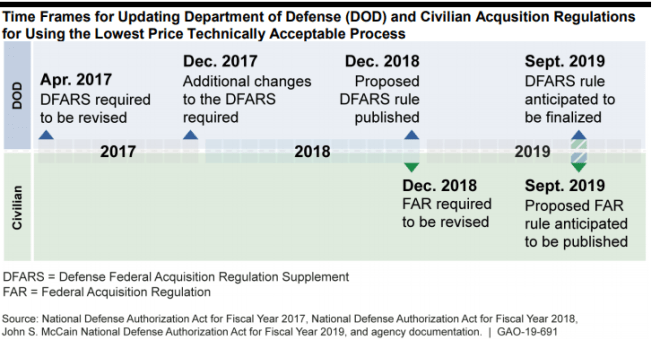
The U.S. Defense Department will on September 26, 2019 publish a long-awaited final rule to implement Congress’ curbs on low-price awards.  Unlike European governments, since World War II the U.S. government has come to rely heavily on multilateral competitive negotiations which trade off price and quality to ensure best value.  Recent years, however, saw a resurgence of “lowest price technically acceptable” (LPTA) procurement – an award to the vendor that offers the cheapest good or service that is technically acceptable.  The final rule, which reflects Congress’ concerns that the low-price method is used too often and inappropriately, may slow the use of LPTA awards.

Source: GAO Report GAO-19-691 (published Sept. 26, 2019).

Many have argued that the LPTA procurement method is a throwback to a more primitive form of procurement based on low price.  Contracting officials, however, have embraced this return to low-price procurement.  Critics have suggested that this is because low-price awards are easier to implement and explain, they reduce the nominal prices paid by the government, and awards based on low price allow contracting officials to avoid the often sticky questions raised by technical and past performance evaluations.  Because price is simple and technical issues are often quite difficult for contracting officials to master, critics of the LPTA method have argued that focusing on low price reduces administrative costs and risks for contracting officials, even if the award does not result in the best value for users – a classic “agency” problem in procurement.

After long debate and numerous studies noting industry’s opposition to low-priced awards, Congress passed a series of laws intended to curb the use of the LPTA method in federal procurement.  Despite early Pentagon guidance urging caution in the use of the LPTA method, Defense Department regulators took long (several years, though Congress had called for swift action) to prepare and publish a final rule implementing those statutory restrictions.  Operational guidance for Defense Department contracting officials is being published as well, and civilian agency requirements will be addressed separately under a government-wide rule currently under review.

Source: GAO Report GAO-19-691 (published Sept. 26, 2019).

The final rule reflects a restrictive implementation of Congress’ curbs on low-price awards; in fact, the new rule is in many ways merely a “copy-and-paste” of the statutory requirements.  Regulators repeatedly rejected suggestions to clarify, for example, that low-price awards should be limited to non-complex acquisitions.  Regulators argued that where Congress did not impose a specific bar on low-price awards, further limitations should not appear in the rule – a markedly narrow approach, given the broad discretion allowed U.S. regulators when implementing legislation.

Despite regulators’ cautious approach, the final rule does impose important limitations on the use of the LPTA method:

  • Contracting officials will have to document (but not necessarily publish) why they chose to use the LPTA method.
  • Certain goods (such as personal protective equipment to be used in combat) are not to be purchased using the LPTA method.
  • The LPTA method is to be avoided in contracts and orders unless:
    • Requirements can be described “clearly and comprehensively”
    • Little value will be gained from a proposal that exceeds minimum technical requirements
    • The technical requirements require little subjective assessment
    • Review of the technical proposals is probably not valuable
    • A different procurement method is unlikely to spur innovation
    • The goods to be purchased are expendable or non-technical
    • The contract file explains why the lowest price will reflect full life-cycle costs

Regulators’ comments to the final rule acknowledged that the government does not hold data on how often the LPTA method is actually used in practice.  If, in response to this final rule, industry continues to press Congress for further limitations on low-price awards, future reforms may focus on the need for data on LPTA awards, and on greater transparency in contracting officials’ decisions to make awards based on low price.

Editor’s note: This post was updated on September 26, 2019 to include the two charts from GAO Report GAO-19-691, which was published after the final DFARS rule was released.

ABA Public Contract Law Section – International Procurement Committee – Presentation on International Trade Agreements – October 10, 2019 – Noon to 1:30 pm

Join a special presentation on the United States’ international trade agreements in procurement. Chris Yukins and Allen Green will present on their chapter in The Contractor’s Guide to International Procurement (American Bar Association 2018) (Erin Loraine Felix & Marques Peterson, eds.). They will give an overview of international trade agreements, and discuss recent “Buy American” developments in the Trump administration. The program will be held at the Dentons law firm, 1900 K Street NW, from 12-1:30 pm. Lunch will be served.

Call-in information: +1-877-211-3621 Passcode: 788 499 1844

International Trade Agreements and U.S. Procurement Law

Chapter by Christopher R. Yukins & Allen B. Green, in The Contractor’s Guide to International Procurement (American Bar Association 2018) (Erin Loraine Felix & Marques Peterson, eds.)

Available at: https://ssrn.com/abstract=3443244

Allen Green
Christopher Yukins

Some of the most difficult issues in U.S. procurement law stem from the nation’s several centuries of accumulated protectionist measures, and from a patchwork of trade agreements meant to contain that protectionism. These conflicting measures reflect a push-and-pull in U.S. procurement policy, between those who favor closed procurement markets and those who favor open competition; the compromises reached between the two camps have created a Byzantine set of rules and requirements. At the same time, though, this area of law holds a special promise for the future of procurement, for cross-border agreements currently offer the readiest means of erasing anti-competitive differences between national rules, by bringing many nations to a common standard of international best practice. To make sense of this complex area, this chapter proceeds in three parts. Part II reviews the major pieces of protectionist legislation passed by Congress, focusing first on the Buy American Act of 1933; this discussion also references some of the most important implementing regulations. Part III reviews the most important U.S. trade agreements which have limited the force of that protectionist legislation, including the World Trade Organization’s Agreement on Government Procurement (GPA). Because barriers to procurement can also arise from structural factors — “non-tariff barriers to trade” which, in practice, may protect domestic vendors — this part also explains how the trade agreements mitigate those non-tariff barriers. Finally, Part IV concludes by offering some practical suggestions for those working in this field, and suggests a possible road ahead for cooperation in international procurement markets.

Yukins, Christopher R. and Green, Allen, International Trade Agreements and U.S. Procurement Law (2018). Chapter 9 to The Contractor’s Guide to International Procurement (American Bar Association 2018) (Erin Loraine Felix & Marques Peterson, eds.); GWU Law School Public Law Research Paper No. 2019-55; GWU Legal Studies Research Paper No. 2019-55. Available at SSRN: https://ssrn.com/abstract=3443244